
I can hardly watch movies anymore. Most of them feel like hollow performances, as if they are missing a soul. But there is one story that has never let go of me: The story of
Noah.
Many years ago, I watched Noah (currently available on Netflix). What touched me was not the ark itself, the water, or the animals. It was something much deeper. A question that has continued to grow within me ever since:
Who do we humans think we are?
When I look around at what we have made of this earth, how we treat animals, children, one another, and everything entrusted to our care, I understand why this story still refuses to leave me.
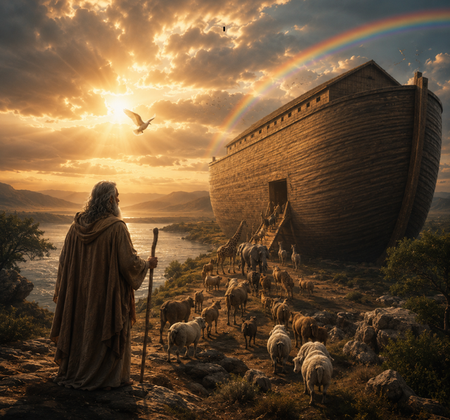
We live in a world filled with wonders and behave as though everything may be used, possessed, distorted, or sacrificed, as long as it serves our desires, our interests, or our beliefs
In Genesis, Noah receives very specific instructions. God tells him that the earth has become corrupt, that violence has filled it, and that the world as it is will come to an end. Then follows a
precise assignment: build an ark of gopher wood, make rooms in it, and coat it inside and out with pitch. Its dimensions are given: length, width, and height. There must be a door, a window, and
multiple levels.
It is not a vague feeling, but a clear and directed instruction with form, purpose, and direction
He is told to bring his wife, his sons, and their wives. He is also instructed to bring the animals: two of every kind, male and female, and more of the clean animals. Food must be gathered for both humans and animals. Noah does not receive an abstract warning, but a complete preparation. He was not only called to believe; he was called to build, organize, gather, and preserve.
Exactly how God spoke to him is left open in Scripture. Was it an audible voice, a dream, a vision, or a deep inner knowing? That is significant. The emphasis is not on how it happened, but on the recognition of Truth and the obedience that follows it.
Noah recognized the voice of God because what he received did not originate from his own ego
It brought him neither fame, comfort, nor power. On the contrary, it led him into separation, ridicule, hard labor, and complete surrender. He was asked to build something that appeared utterly
insane to the outside world. That is often how a true calling works: it does not make a person greater in themselves, but smaller before something greater than themselves.
He stood in the midst of a corrupted world and saw what others refused to see. While the people around him lived as though the earth, the animals, and even other human beings belonged to them, Noah understood that everything is merely entrusted to us. He saw the root of corruption: the human being who places himself at the center of existence and from that position decides what truth is, what has value, and who may suffer.
The people around him had eyes, but their vision had become clouded by desire, fear, habit, and self-interest. Slowly they had come to believe that their way of living was normal. Violence became
justified, greed became admired, and power became something worthy of praise. That is how truth slowly slips away from a society without anyone truly noticing, until eventually what is wrong is
accepted as normal.
Noah saw the consequences
He saw where a world is headed when humanity places its own will above the order of life. That is why he built. Out of humility. To preserve life.
God allowed the waters to rise because the corruption had become too deeply rooted.
Violence, deception, and the denial of everything sacred had saturated the earth to such a degree that only a great cleansing could create room for something new. The waters did not merely wash people away; they washed away an entire way of life, a civilization that had declared itself to be god and had damaged everything around it.
Eventually the flood came. The ark was sealed. Noah waited with his family and the animals. He sent out the raven and later the dove. The waters receded. After the disaster, he offered a sacrifice, and God established a covenant with him, sealed by the rainbow as a sign that the earth would never again be destroyed in that way.
Today, in 2026, I recognize the same movement
We possess more knowledge and technology than ever before, yet our connection with life itself seems to be fading more and more. Children grow up in confusion, animals are treated as products, wars are fought in the name of peace, and humanity still declares itself the highest authority.
Sometimes, deep within myself, I can understand why God would allow the waters to rise again.
When I see humanity repeating the same patterns, when wars continue, children are broken, the earth is exhausted, and people continue to wound one another, a quiet recognition emerges. As though a great cleansing sometimes appears to be the only way to wash away everything false and corrupted, creating space once again for purity.
And yet, hope burns within me.
A quiet and profound certainty
For God still speaks, just as He spoke to Noah.
When a person truly learns to listen, it becomes clear why they are here.
A unique calling reveals itself, sometimes gently, sometimes irresistibly, and it becomes clear what is being asked of them.
The real question remains whether we respond, whether we are willing to build as Noah built, even when no one understands
Within that same humility lies our true greatness. In reverence for life. In caring for what has been entrusted to us and in the love with which we treat all living things.
There, within that simple truth, we ultimately come home.
As guardians of a sacred gift, connected to everything that breathes and grows, ready to listen, to serve, and to protect, just as Noah did.
Perhaps then something beautiful may arise on this earth once again.
Rani Savitri