
Throughout the centuries, the name of Solomon has become almost synonymous with wisdom. When people speak about him, the image appears of a king who could see what others could not, a man to whom
rulers traveled in order to hear him speak, a leader under whose reign a kingdom flourished and in Jerusalem a temple arose that was meant to show that the sacred could dwell in the midst of a
people. Generations have held on to that image and still speak with admiration about his insight, his judgment, and the greatness of his kingdom.
What is rarely truly acknowledged, however, is that the story of Solomon does not end in wisdom. It ends in a fracture that reaches far deeper than the life of a single king and that still runs through the world today.
At the beginning of his reign Solomon stood as a young man before a task greater than himself. The kingdom that his father David had built through struggle now lay in his hands, and the responsibility of ruling over a people weighed heavily on his shoulders. In a dream he was addressed by God, and in that moment he was asked a question that very few people are ever given.
“What do you desire?”
Before him lay the possibility of asking for everything a human being normally longs for: wealth, power, victory over enemies, or a long life. Yet his desire moved in another direction. He asked for wisdom, for a heart that could listen and discern what was good and what was evil, so that he could guide the people with justice.
That wisdom was given to him.
What is often forgotten is that God immediately attached a condition to that gift. The wisdom Solomon received could remain pure only as long as his heart remained connected to the source from which it came. As long as love for God remained the ground upon which his wisdom rested.
In the years that followed it seemed as though everything arranged itself around that gift. Jerusalem grew into a center of trade and influence, peace settled over the land, and from all directions people came to hear him speak. In that same period Solomon developed the desire to build a house for God, a place that would visibly show that the sacred could dwell among people.
On the mountain in Jerusalem a temple began to rise, built from stone, cedar wood and gold brought from distant lands. What arose there was unprecedented for its time and was meant to become a place where heaven and earth could meet. When the temple was dedicated Solomon prayed that God would dwell there and that the people would be heard when they turned their hearts toward Him.
For a time everything seemed to exist in harmony.
Yet during those same years a shift slowly began to take place in the life of the king. Wealth continued to flow into the city, and with wealth came political alliances. Those alliances brought marriages with women from many nations, and with them came their rituals and their gods. On the hills surrounding Jerusalem altars began to appear that had once been unthinkable.
His mind remained sharp and his ability to rule remained great, while his heart slowly became divided. The love for God, which had once been the source of his wisdom, gradually lost its central place. What remained was an intelligence that could still analyze and organize, but that had lost its direction.
There lies the true meaning of his fall.
Not the loss of wisdom, but the loss of love
Wisdom can build a kingdom, raise a temple and impress a world, while the heart quietly becomes divided between loyalty and power. Once that division arises, wisdom slowly turns into strategy, diplomacy and control. A person can still act impressively and accomplish great things, while the core of his life begins to grow empty.
There stands the human being with all his wisdom.
Empty.
After Solomon’s death it became visible what had slowly been building during his reign. The kingdom that had once been one broke apart, distrust grew between the tribes, and the temple that had once been meant as a place of encounter with God gradually became a place where religion, identity and power began to struggle with one another.
The history that followed carries the consequences of that fracture. The temple was destroyed, new empires conquered Jerusalem, and different religions laid claim to the same sacred place. Crusades, conquests and wars followed one another, while that same mountain in Jerusalem remained a focal point of tensions that still touch the world.
What is happening in that region today shows that this fracture has never truly been healed. Wars around Israel, Gaza, Syria, Iran and Iraq show how a history that began thousands of years ago continues to echo into the present.
And precisely there it becomes clear that this story is ultimately not about Solomon
It is about us.
It is about humanity.
Solomon symbolizes something that lives within every human being. In the heart of humanity lives the desire for wisdom, for insight, for order and for control over life. In that same heart also lives the desire for power, possession and security. Once those forces divide the heart, the same division appears outside the human being in borders, conflicts and wars.
The history of the world shows how that inner fracture repeats itself again and again.
We see that same movement in another place in the world, where a people once lived who carried a wisdom that many civilizations have never truly understood. On the continent that would later be called America there lived peoples for centuries who lived in deep connection with the earth. They did not see the earth as property, but as a living reality in which the human being has a place.
Their lives were built upon respect for the land, for animals, for water and for the generations that would come after them. Their wisdom did not arise from domination, but from listening to life itself. In their words and traditions the same recognition echoes again and again: nothing truly belongs to us.
Everything is given to us in trust.
When the colonists arrived, those peoples were almost entirely wiped out. Villages were destroyed, land was taken, and people were slaughtered on a scale that is difficult to comprehend. Civilization called it progress. Advancement. Wisdom.
And yet it was precisely a people who carried an insight the modern world still struggles to understand who were destroyed.
Who, then, are truly the primitive ones?
The human being who believes the earth belongs to him, or the human being who understands that he himself belongs to the earth.
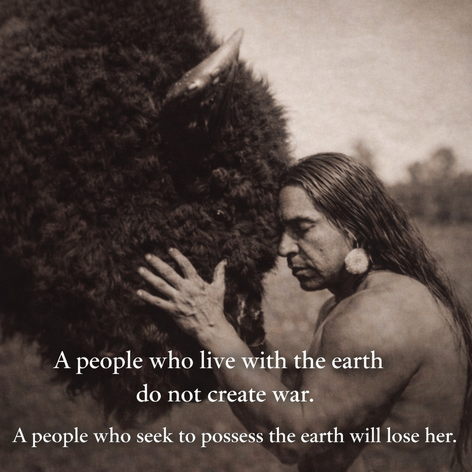
The photograph of the Native man placing his forehead against the head of a bison reveals a truth older than our civilizations. In that gesture you see a human being who does not attempt to possess life, but who knows he is part of it. His posture reminds us of a reality in which the human being does not place himself above creation.
Love is the highest form of understanding
Where love is present, wisdom arises naturally. Where love is absent, wisdom can become a force that destroys.
That is what happened to Solomon.
That is what happens to us.
The world we know today is the result of a humanity that has learned to be clever, to analyze, to organize and to build, while losing the simplest insight.
Nothing belongs to us.
Everything is given
Whoever truly understands that does not wage war.
How many wars will still be needed before humanity receives the insight that some peoples had already understood long ago?
As long as humanity seeks wisdom without love, it will build temples, establish kingdoms and create civilizations that ultimately turn against itself.
A people who live with the earth do not create war.
A people who seek to possess the earth will lose her.
Rani Savitri